
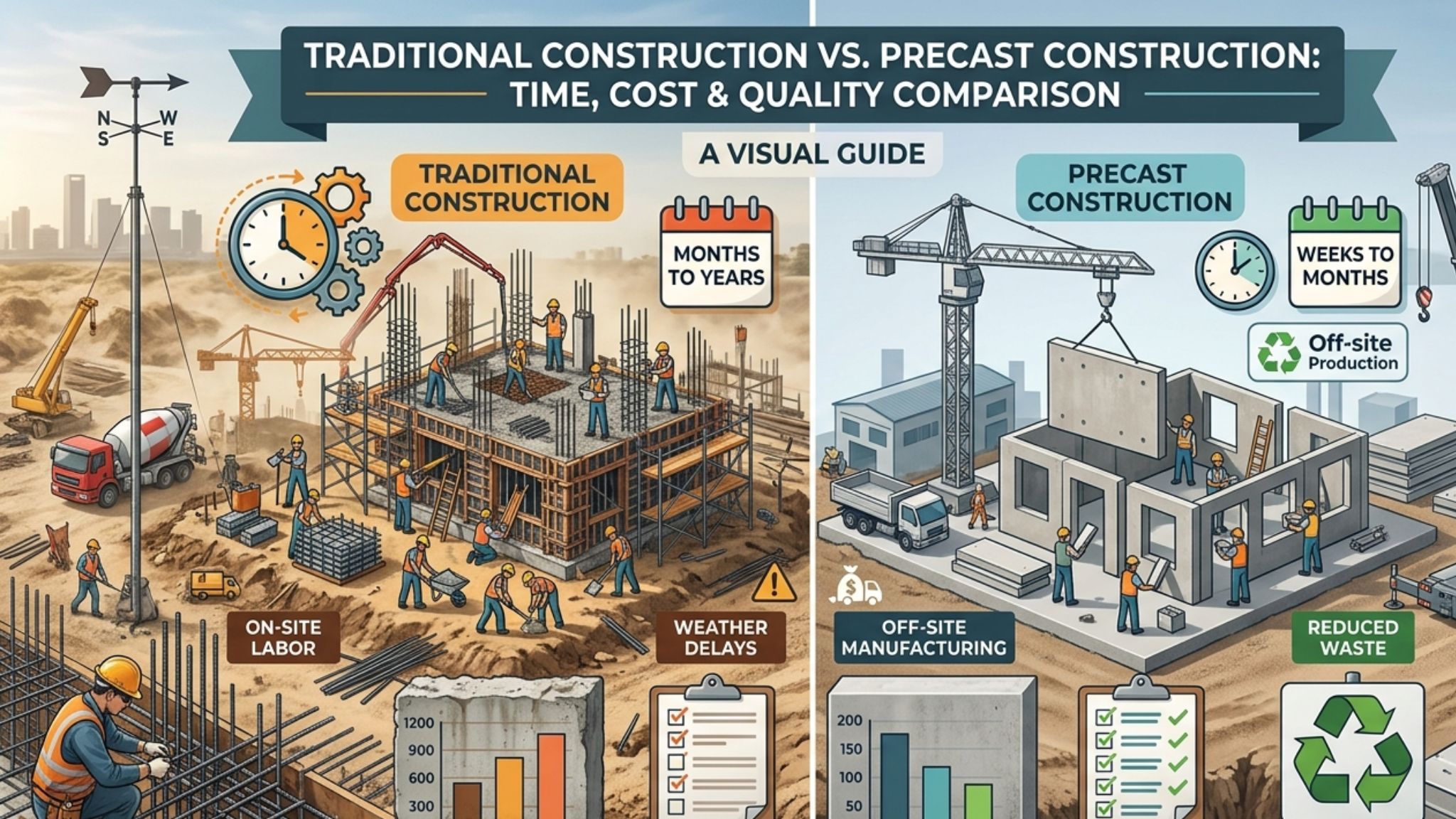
The construction industry has always acted as a cornerstone of economic growth and urban development. As cities develop and infrastructure needs rise, builders and developers are under mounting pressure to deliver projects faster, at lower costs, and with higher quality standards. Traditionally, construction relied on on‑site processes, where raw materials were assembled piece by piece. Today, precast construction offers a modern alternative, manufacturing components within controlled environments before transporting them to the site.
In both approaches, the role of a construction material wholesaler is vital. Wholesalers ensure that builders have access to the right materials like cement, steel, aggregates, and precast elements on time and at competitive prices.
Traditional Construction: The Conventional Approach
Traditional construction involves building structures directly on‑site using raw materials such as cement, bricks, sand, and steel.
How Traditional Construction Works
Traditional construction is the age‑old method of building directly on‑site. It relies on raw materials such as cement, bricks, sand, and steel supplied by a construction materials wholesaler and involves sequential processes that unfold step by step.
- Site Preparation: Clearing land, levelling, and installing foundations.
- Material Delivery: Wholesalers provide cement, aggregates, and steel reinforcement bars.
- On‑Site Mixing: Concrete and mortar are mixed manually or with basic machinery.
- Structural Assembly: Walls, beams, and slabs are built layer by layer.
- Finishing Work: Plastering, painting, and roofing are completed after the main structure is erected.
This approach allows adaptability in design changes but is highly dependent on weather conditions, labour skill, and material availability.
Strengths
- Flexibility: Designs can be modified during construction.
- Local Labour: Employs local workers, supporting community economies.
- Material Availability: Relies on widely available materials supplied by wholesalers.
Weaknesses
- Time‑Consuming: On‑site processes are slower due to weather delays and manual labour.
- Higher Costs: Lengthened timelines increase labour and overhead expenses.
- Quality Variability: Dependent on workmanship, resulting in inconsistencies.
Precast Construction: The Modern Alternative
Precast construction involves manufacturing building components such as walls, beams, and slabs in controlled factory environments. These components are then transported to the site for assembly.
How Precast Construction Works
Precast construction shifts much of the building process away from the site into controlled factory environments. Components are manufactured with accuracy, then transported and assembled on‑site.
- Design & Engineering: Detailed plans are created to ensure components fit perfectly.
- Factory Production: Using moulds, concrete is poured and cured under regulated conditions.
- Quality Control: Each part is tested for strength, durability, and compliance with standards.
- Transportation: Large precast slabs, beams, and walls are delivered to the site.
- On‑Site Assembly: Cranes and specialised equipment position components quickly and efficiently.
This method dramatically reduces construction time, ensures consistent quality, and limits waste, though it requires careful logistics and a greater upfront investment.
Strengths
- Speed: Faster project completion due to parallel off‑site production.
- Consistency: Factory production ensures uniform quality.
- Reduced Waste: Efficient use of materials lowers environmental impact.
- Durability: Precast elements are engineered for strength and longevity.
Weaknesses
- Transport Costs: Moving large precast elements can be expensive.
- Design Restrictions: Less flexibility for eleventh-hour changes.
- Initial Investment: Requires specialised equipment and planning.
Time Comparison
- Traditional Construction: Projects often take longer due to reliance on weather, manual labour, and sequential processes.
- Precast Construction: Components are manufactured while site preparation occurs, cutting overall timelines by up to 50%.
Verdict: Precast construction is significantly faster, rendering it ideal for large‑scale projects and urban developments.
Cost Comparison
- Traditional Construction: Costs accumulate through prolonged labour, material spoilage, and delays.
- Precast Construction: Elevated upfront investment but reduced long‑term expenses due to efficiency and lower maintenance.
Verdict: Precast construction offers greater long-term financial savings, though standard methods may suit smaller, budget‑constrained projects.
Quality Comparison
- Traditional Construction: Quality depends on workers’ skills and site conditions, resulting in variability.
- Precast Construction: Factory‑controlled environments ensure consistent quality, precision, and compliance with standards.
Verdict: Precast construction delivers superior quality and durability, especially for state-of-the-art infrastructure.
Role of a Construction Material Wholesaler
A construction material wholesaler is the backbone of both traditional and precast projects. Their role includes:
- Supply Chain Efficiency: Guaranteeing timely delivery of cement, steel, and aggregates.
- Expense Management: Large-scale buying lowers material costs.
- Quality Assurance: Providing certified, reliable materials.
- Adaptability: Supporting both traditional builds and precast manufacturing plants.
By partnering with a trusted wholesaler, builders can reduce delays, manage budgets, and preserve consistent quality.
Prospects of Construction
The future lies in combined methods that combine the flexibility of traditional construction with the efficiency of precast methods. As urbanisation accelerates, precast solutions will dominate large projects, whereas traditional methods will remain relevant for smaller, customised builds.
Conclusion
The choice between traditional and precast construction depends on project scale, budget, and timeline. Traditional construction gives flexibility but is slower and less consistent. Precast construction delivers speed, cost savings, and superior quality, making it the preferred option for state-of-the-art infrastructure.
Looking for a trusted construction material wholesaler to support your next project? Visit Zhuzoor today to access top-quality materials for both traditional and precast construction. With Zhuzoor, you’ll save time, reduce costs, and ensure premium quality for every build.
Frequently Asked Questions (FAQs)
What is the main difference between traditional and precast construction?
Traditional construction builds structures on‑site using raw materials such as cement, bricks, and steel. Precast construction, on the other hand, manufactures components such as walls and slabs in a factory setting before transporting them to the site for assembly.
Which method is faster: traditional or precast construction?
Precast construction is generally faster because components are produced off‑site while site preparation is happening simultaneously. Traditional construction is slower since every stage must be completed sequentially on‑site.
How does a construction material wholesaler support these methods?
A construction material wholesaler provides timely delivery of cement, steel, aggregates, and precast elements. They help reduce delays, control costs through volume buying, and ensure the use of certified-quality materials for both traditional and precast projects.
Is precast construction more expensive than traditional construction?
Precast construction requires increased upfront investment due to factory production and transportation costs. However, it often saves money in the long run by reducing labour costs, cutting waste, and lowering maintenance costs compared to traditional methods.
Which method delivers better quality?
Precast construction delivers more consistent quality because components are manufactured within regulated conditions. Traditional construction quality depends heavily on site conditions and workers’ skill, which can lead to variability.
READ POST